Alexandra Duarte Opposes Prop. 3. If It Fails, a Tax That Helps Pay for Special Education and Other School Programs Expires in 2031.
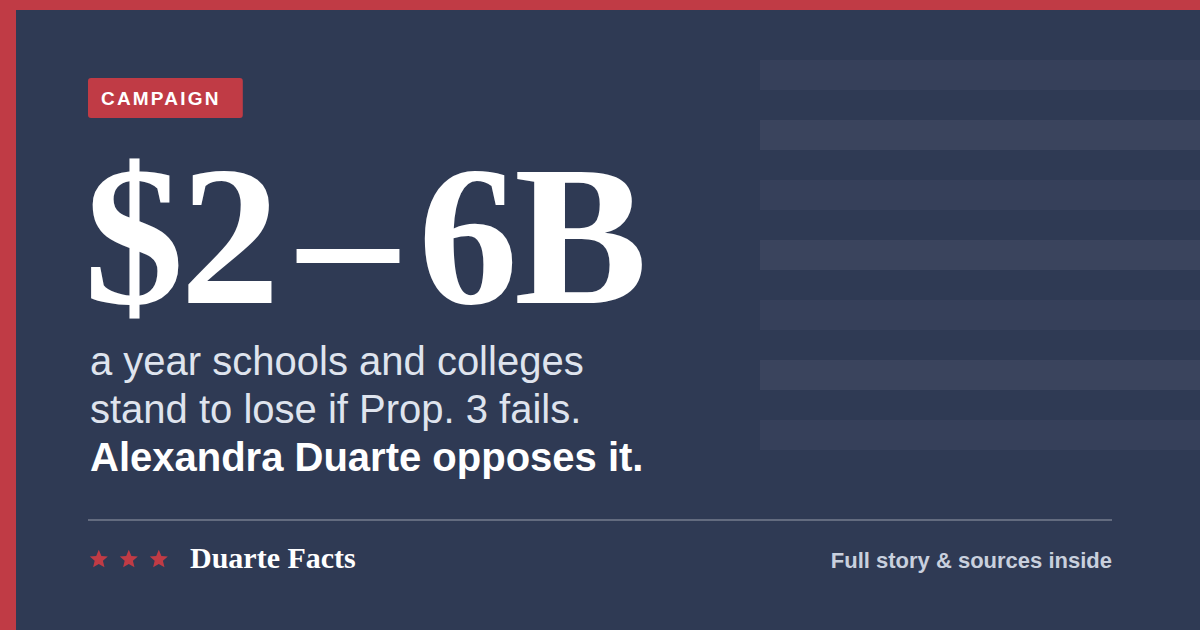
Prop. 3 would make permanent a 2012 income tax on the state’s highest earners. The Legislative Analyst estimates it would bring in $5 billion to $15 billion a year, roughly 40% of it for schools and community colleges. Duarte calls it “another classic state tactic.”
On Nov. 3, California voters will decide Proposition 3, which would make permanent the higher income tax rates on the state’s top earners that voters first approved in 2012. If it fails, those rates expire in 2031. Most of the money from the tax that goes to education goes to K-12 schools, and it has helped pay for special education, among other programs.
Alexandra Duarte opposes it. Asked at a September forum whether she supported Prop. 3, she said: “This is another classic state tactic. ‘Let’s increase taxes; we’re out of money.’” She added: “Increasing taxes will not fix the problem.”
What Prop. 3 does
The tax applies only to the highest incomes in the state: single filers who make more than $371,000 a year and couples filing jointly who make more than $743,000, LAist reports. Those thresholds rise each year with inflation. “The top 2 percent of California taxpayers pay these higher rates,” according to the Legislative Analyst’s Office, the Legislature’s nonpartisan fiscal adviser. The office estimates that keeping the tax would bring in $5 billion to $15 billion a year, depending largely on the stock market. “Roughly 40 percent of the funding would go to schools and community colleges,” the analyst’s office says. That is about $2 billion to $6 billion a year. The rest would go to other state programs, with part set aside in reserves. CalMatters reports that 89% of the education share goes to K-12 schools and 11% to community colleges, and that local school boards decide how to spend it.
What it pays for
“Revenue from this source has helped pay for special education, community schools, before- and after-school programs, summer learning, teacher support, dual enrollment in college courses, bilingual education, and universal school meals,” according to Ed100, a nonprofit education guide.
Supporters say losing it would mean cuts. The California Teachers Association, which put the measure on the ballot, says that without it, “our public schools face a devastating 15% budget cut; 1 in 6 educators would face layoffs.” Those are the union’s estimates. The official ballot arguments for the measure, signed by the leaders of the teachers association, the California School Nurses Organization and Planned Parenthood Affiliates of California, warn of “teacher layoffs, overcrowded classrooms and bigger class sizes.”
Opponents, including the Howard Jarvis Taxpayers Association and the Central Valley Business Federation, argue that the tax was promised as temporary. “California doesn’t have a revenue problem. We have a spending problem,” their ballot argument says.
What it could mean in Modesto
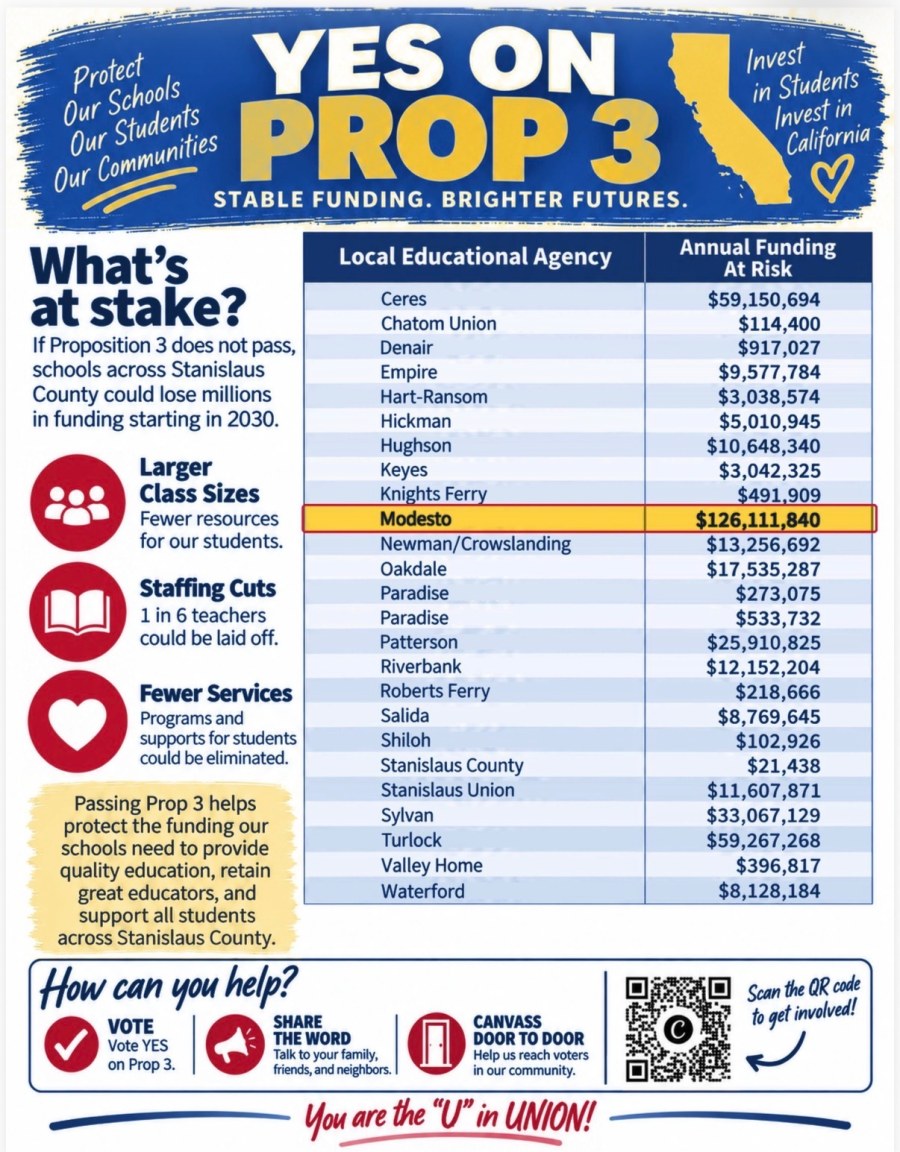
A flyer from supporters of Prop. 3 that closes, “You are the ‘U’ in UNION!” lists the “Annual Funding At Risk” for each school district in Stanislaus County. Modesto City Schools tops the list at $126,111,840 a year. Next are Turlock ($59.3 million), Ceres ($59.2 million), Sylvan ($33.1 million) and Patterson ($25.9 million). If Prop. 3 does not pass, the flyer says, “schools across Stanislaus County could lose millions in funding starting in 2030,” and it warns of larger class sizes, staffing cuts and fewer services. The figures are the flyer’s estimates; it does not say how they were calculated.
The state’s own numbers point to a smaller loss. The Legislative Analyst’s Office estimates the tax brings in $5 billion to $15 billion a year, roughly 40% of it for schools and community colleges, and CalMatters reports that 89% of that education share goes to K-12 schools. That is about $1.8 billion to $5.3 billion a year for K-12 schools statewide, or roughly $300 to $900 for each of the state’s 5.8 million students. Modesto City Schools, with about 30,100 students, makes up about 0.5% of that enrollment. By that measure, its share would be roughly $9 million to $28 million a year. That is our estimate, not an official one; actual amounts depend on the state’s funding formulas, which send more money per student to districts like Modesto with many low-income students and English learners. The flyer’s figure works out to about $4,200 per Modesto student. Applied statewide, that rate would come to more than $24 billion, more than the analyst’s highest estimate of what the entire tax raises.
Modesto City Schools’ own budget shows how little room it has. The district’s adopted 2025-26 budget projects $571.9 million in general fund revenue and $583.7 million in spending, about 84% of it on salaries and benefits.
The district already plans to spend more than it takes in from its main, unrestricted funds for three straight years: $16.4 million in 2025-26, $12.9 million in 2026-27 and $4.3 million in 2027-28. Its unassigned balance, the money not set aside for required reserves or other commitments, is projected to fall from $49 million at the end of 2024-25 to $4.1 million by 2027-28.
Special education already costs more than the state and federal money set aside for it. To cover the gap, the district shifts money from its unrestricted budget: $68 million in 2025-26, rising to $71.8 million by 2027-28, the budget projects.
What Duarte has said
At the September forum, Duarte argued that “businesses can provide a sound economy so that California can be the amazing state that it has the ability to be.” She did not say, in the Turlock Journal’s account, how schools would replace the money if the tax expires, and we found no statement from her on that question. Her opponent, Democrat Jaron Brandon, whose campaign publishes this site, described the measure as an existing tax on the highest income bracket that would bring in “$5 billion to $15 billion a year for education.”
Alexandra Duarte, a Republican, is running for California State Senate District 4 on the Nov. 3, 2026, ballot. She is married to former Rep. John Duarte, who has served as president of Duarte Nursery.
Sources
- California Legislative Analyst’s Office, Proposition 3 analysis, Nov. 3, 2026 ballot(opens in new tab)
- California Secretary of State, Official Voter Information Guide, Proposition 3, arguments and rebuttals(opens in new tab)
- CalMatters, “Proposition 3: High-income tax,” 2026 voter guide (Oct. 1, 2026)(opens in new tab)
- LAist, “Prop. 3: income tax on high earners,” 2026 voter guide(opens in new tab)
- Ed100, Carol Kocivar and Jeff Camp, “Education on the California ballot, 2026” (Sept. 9, 2026)(opens in new tab)
- California Teachers Association, “Yes on Prop. 3” (July 22, 2026)(opens in new tab)
- EdSource, Diana Lambert, CTA campaigns for Prop. 3 (Aug. 27, 2026)(opens in new tab)
- Turlock Journal, “Mayoral, city council, state senate candidates face off in local debates” (September 2026)(opens in new tab)
- Yes on Prop. 3 union flyer, “What’s at stake?” (“Annual Funding At Risk” by Stanislaus County local educational agency). Photograph submitted to Duarte Facts.
- Modesto City Schools, “Approval of Certification of the 2025/6 Budget for all Funds,” Board of Education regular meeting, June 23, 2025 (Budget Adoption Certification report: General Fund summary, multiyear projection and components of ending fund balance; 2025-26 enrollment 30,095)(opens in new tab)
- California Department of Finance, 2025-26 Enacted Budget Summary, TK-12 Education (“roughly 5.8 million students in grades transitional kindergarten (TK) through twelve”)(opens in new tab)
Lawsuit allegations are claims, not findings, unless a court ruled. See something wrong? How to request a correction.
Read more: Alexandra Duarte for Senate: the full record
More from the record
Who’s Paying for Alexandra Duarte’s Campaign? Start With Big Tobacco.
Philip Morris USA, the maker of Marlboro, gave Duarte the $5,900 maximum while a vaping bill its lobbyists worked on was pending. Nine donors with records of misconduct or a stake in what Sacramento decides have given her campaign $45,400.
John Duarte Called a Water Board Inquiry a “Witch Hunt.” The Accused Director’s Family, Partners and Businesses Have Given Alexandra Duarte $26,000.
A Modesto Irrigation District director was accused of using district water on out-of-district almonds. His ranch partners, the Angle family, have given to the Duartes for years, have helped run Alexandra Duarte’s east-side water company, and supplied more than half the money raised by a water board challenger John Duarte endorses.
Republicans Condemned Alexandra Duarte’s Gun Mailer for “Troubling Imagery Implying Violence.” Her Other Mailers Called a Rival “Creepy.”
Before the June primary, the California Republican Party and five county and regional Republican groups criticized Duarte’s campaign. Her mailers attacked her Republican rival over transgender policy. Against Democrat Jaron Brandon, they use what one calls his “real mugshot.”